
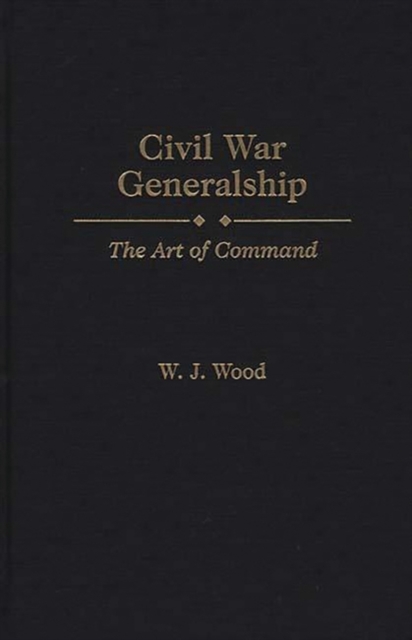
Civil War Generalship
W.J. Wood
Format
Hardcover
Antall sider
288
Vekt
539 g
Forlag
Bloomsbury Publishing Plc
ISBN
9780275950545
Språk
Engelsk
1510,-
Trykkes på forespørsel. Forvent litt lengre leveringstid.
Om boken
This study challenges both the accepted convention that the American Civil War was the first modern war and the myth that Civil War leaders were guided by foreign and American military thought in fighting their war. Wood's work takes an innovative approach by selecting three typical higher level commanders on each side, Union and Confederate, and then pairing them off in the campaigns and battles in which they actually confronted each other. While readers gain insight into the nature and character of a commander, they can, at the same time, observe how each put his art of command into practice. Civil War commanders at the operational level had to confront not only their opponents on campaign and in battle, they also had to develop—even create—their own method of command through their personal on-the-job training, while actually engaged in combat operations. This is the first study of Civil War command since Douglas Southall Freeman's Lee's Lieutenants (1944) that has focused solely and directly with the problems and methods of operational command; in so doing, the author has dealt with the tactical and strategical problems that threatened to overwhelm untried Civil War generals at the very onset of hostilities. The failure of antebellum American military thought to come to grips with outdated linear tactics and inapplicable strategical principles resulted in commanders on both sides in the Civil War having to lead mass armies of untried civilian soldiers into a war for which neither the led nor the leader had been prepared to fight. Higher level commanders on both sides were forced to create and develop a personal art of command while actually putting it into practice on campaign and on the battlefield. In so doing—however well or badly managed—the typical commanders under observation developed a pragmatic art that has left a legacy that still provides paradigms for military leaders in the late 20th century. The book examines three pairs of opposing commanders: Stonewall Jackson and Nathaniel Banks at Cedar Mountain; William Rosecrans and Braxton Bragg at Chickamauga; and John Bell Hood and George H. Thomas at Nashville. For each battle, the study analyzes how these leaders planned and conducted operations, providing insight into their character and command decisions. The work concludes by reviewing how the character of each commander affected the development of his art of command and examines the legacy left by these founders of a pragmatic approach to warfare.