
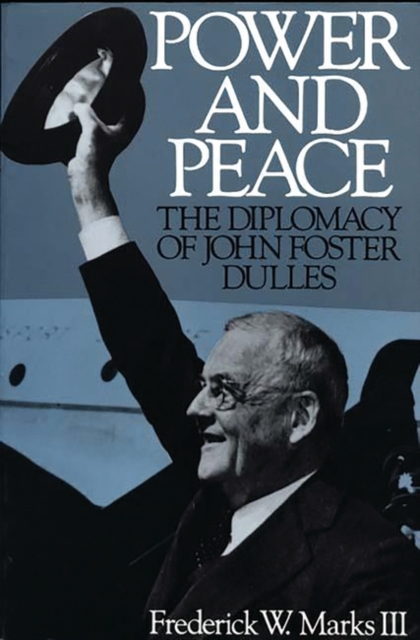
Power and Peace
Frederick Marks
Format
Paperback
Mål
234 × 155 × 21 mm
Antall sider
296
Vekt
444 g
Forlag
Bloomsbury Publishing Plc
ISBN
9780275952327
Språk
Engelsk
460,-
Trykkes på forespørsel. Forvent litt lengre leveringstid.
Om boken
This revisionist study—the first full-length treatment of Dulles since 1973—argues that Dulles, working alongside Eisenhower, inaugurated the first era of Soviet-American détente and helped Ike lead the United States through eight years of unparalleled peace and prosperity. In contrast to the critics who have portrayed him as the personification of the Cold War mentality, the author makes the case that he was eminently flexible behind the scenes and as pragmatic as was possible during a period of rampant McCarthyism. John Foster Dulles' reputation among diplomatic historians has been at a low ebb for many years. The fact that it is only now beginning to show signs of recovery is surprising considering that his modus operandi, coupled with a public style that concealed as much as it revealed, enabled him to gain the respect of hundreds of overseas officials, including those of the USSR. The cutting edge of an extraordinarily subtle and complex mind made it possible for him to lead the United States through eight years of unparalleled peace and prosperity. This work offers the first comprehensive analysis of Dulles' operational plan and is unique for the type of linkage uncovered between different issues in different parts of the world. It differentiates Dulles from Eisenhower, showing that, contrary to conventional wisdom, it was the former who generally took the lead on policy matters. It indicates that Dulles was capable of weighing in heavily on the side of non-intervention and hence was no more of a hawk than Ike, and unveils important differences of opinion separating the secretary from his boss. The author presents some of the most crucial episodes in an entirely new light—for instance the Dien Bien Phu crisis, Western European union, intervention in Guatemala, and Dulles' indispensable work on behalf of Austrian freedom. The work also explores the intellectual side of the secretary, something once again neglected but nonetheless essential since Dulles, of all American statesmen next to John Quincy Adams, was a thinker.